Review: Happy Every Day Embroidery File for Merch
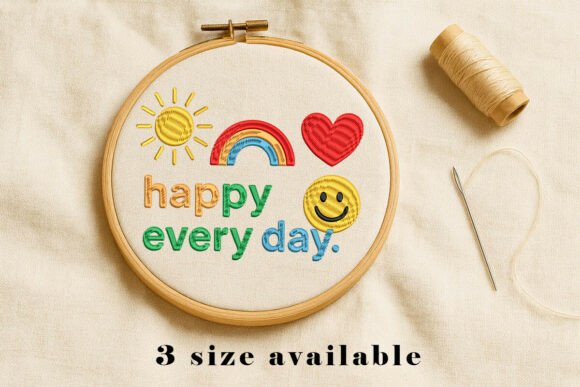
As an embroidery designer who has spent years digitizing logos and testing files for commercial production, I approach every new machine embroidery design with a critical eye. It is not just about whether a pattern looks cute on a screen; it is about how it performs under the needle, how it holds up after washing, and ultimately, how it serves the brand identity of the business using it. Recently, I evaluated the Happy Every Day Embroidery File, a vibrant design featuring colorful text, a smiling sun, rainbow, heart, and smiley face. While categorized under Nursery and often used for baby items, my review focuses on its potential as a versatile asset for small business merchandise, branded patches, and custom apparel.
First Impressions: Visual Personality and Brand Fit
The immediate impression of the Happy Every Day Embroidery File is one of unapologetic joy. In a market saturated with minimalist, rustic, or ultra-modern aesthetics, this design stands out for its playful and decorative nature. For a small business owner, understanding the "vibe" of your digital embroidery file is crucial. This design does not scream corporate elegance or industrial ruggedness. Instead, it communicates friendliness, approachability, and warmth.
For brands in the creative sector—such as bakeries, florists, pet boutiques, or children’s educational studios—this visual personality is a powerful tool. It signals to customers that the business is community-oriented and family-friendly. However, for a law firm or a high-end tech startup, this aesthetic might clash with their desired brand identity. The key takeaway here is intentionality. You are not just buying a pattern; you are buying a mood. If your brand values cheerfulness and accessibility, this design aligns perfectly with those core values.
Real-World Applications for Small Business Merch
When I test a new design, I imagine it in various real-world scenarios. The Happy Every Day Embroidery File offers surprising versatility beyond the obvious nursery applications. Here is how I see it performing in a commercial embroidery context:
- Branded Patches: This is perhaps the strongest use case. Embroidered patches are trending heavily in small business merch. Because this design features distinct elements like a sun and rainbow, it can be isolated or used as a whole to create a cohesive patch. A local café could use this on tote bags sold at the counter, turning customers into walking advertisements.
- Staff Uniforms and Aprons: For businesses like ice cream shops, daycares, or craft studios, staff apparel needs to be inviting. An apron embroidery featuring this design on the chest pocket adds a personal touch that stiff corporate logos lack. It humanizes the staff and makes interactions feel warmer.
- Tote Bag Design: Canvas totes are a staple for Etsy sellers and boutique owners. The colorful text and icons in this file provide excellent contrast against natural cotton or denim. It transforms a generic bag into a statement piece that customers actually want to reuse.
- Cap Embroidery: While possible, cap fronts require careful scaling. The smiley face and sun elements could work well as a small left-chest accent or a side-panel detail, but the full text might be too wide for standard curved caps without significant resizing.
Technical Considerations and Production Challenges
From a technical standpoint, any experienced embroiderer knows that complex, colorful designs come with challenges. The Happy Every Day Embroidery File relies heavily on thread colors to convey its message. When moving from a digital embroidery file to a finished product, you must consider stitch density and fabric texture.
High stitch density can cause puckering, especially on lightweight fabrics like t-shirts or thin tote bags. If you are producing this design for commercial embroidery, using the correct stabilizer is non-negotiable. I recommend a cut-away stabilizer for garments that will undergo frequent washing, such as staff uniforms or customer gifts. For woven items like canvas totes or patches, a tear-away might suffice, but always test first.
Another critical factor is the size of the lettering. The description mentions "colorful text," which implies that readability is key. If you scale this design down too much for a small patch or a hat, the text may become illegible, and the fine details of the heart or smiley face could merge. Always check the minimum hoop size recommended by the digitizer. If that information is not explicitly provided in the product details, you must measure the design in your software and run a test stitch-out before committing to a large production run.
Enhancing Brand Identity and Customer Trust
Why does the choice of embroidery matter for brand identity? Consistency builds trust. When a customer receives a handmade product with a professionally executed embroidered logo or design, it elevates the perceived value of the item. The Happy Every Day Embroidery File, when stitched cleanly with high-quality thread, signals attention to detail.
Consider a local bakery selling cookie boxes. Including a small embroidered tag with this design on the ribbon or packaging accent creates a memorable unboxing experience. It differentiates the brand from competitors who use printed labels. Furthermore, for Etsy branding, having unique design assets like this allows you to create a cohesive look across your shop banner, product photos, and physical items. It helps in creating a printable mockup that accurately represents the final product, reducing customer confusion and returns.
Practical Designer Notes for Implementation
Before you purchase and produce, here is my checklist for integrating this design into your workflow:
- Test in Black and White: Before committing to colorful threads, stitch the design in a single color. This helps you evaluate the stitch path and density without the distraction of color changes. It reveals if the spacing between the sun, rainbow, and text is sufficient to prevent thread breaks or nesting.
- Check Thread Color Contrast: The design relies on brightness. Ensure your thread palette has enough contrast against your base fabric. A yellow sun on a white tote bag will vanish. Plan your color stops carefully.
- Verify Commercial Licensing: As a small business owner, you must confirm that the license for this digital embroidery file allows for commercial use. Most designers do, but always read the terms. You need to know if you can sell items made with this file or if it is for personal use only.
- Create a Mockup: Use a printable mockup or digital rendering to show clients or stakeholders how the design will look on different items. This step is vital for approval before you start stitching bulk orders.
- Fabric Testing: Stitch on the actual material you plan to use. Fabric texture affects the outcome. A fluffy towel will swallow small details, while smooth polyester might show every needle hole. Adjust your tension and stabilizer accordingly.
Final Verdict for Business Owners
The Happy Every Day Embroidery File is a strong contender for businesses looking to inject personality into their merchandise. It is not a subtle design, nor is it intended to be. It is bold, cheerful, and inherently engaging. For small business owners in the nursery, education, food service, or creative crafts sectors, it offers a ready-made solution for adding emotional connection to physical products.
However, success lies in execution. Do not assume that because it is a digital file, it will stitch perfectly on every item. Respect the limitations of hoop size, fabric type, and stitch density. By treating this design as a strategic brand asset rather than just decoration, you can leverage it to enhance customer engagement and boost the perceived value of your handmade products. Whether used on a staff apron, a customer gift, or a retail patch, this design has the potential to brighten every stitch of your business operations.